Our industry is engaged in an important dialogue to improve the efficiency and resilience of real assets through transparency and industry collaboration. This article is a contribution to this larger conversation and does not necessarily reflect GRESB’s position.
At a recent industry panel on climate resilience in real estate, one of the expert panelists’ comments on the state of climate data resonated with me. She said: “We know that these data gaps and challenges are deterring some asset owners or investors from really making those resilience investments.”
This honest observation is one that many of us in the industry recognize. Climate data is still evolving. Models vary, datasets improve over time, and no analysis can remove uncertainty. For organizations used to working with precise financial and operational metrics, that uncertainty can be uncomfortable.
But the same panel also emphasized something of equal importance: uncertainty and imperfect data cannot become an excuse for inaction.
In commercial real estate, the risks associated with climate hazards—from extreme heat to flooding and severe storms—are already affecting buildings and operations today. Waiting for perfect data before acting on resilience can mean delaying investments that protect assets, operations, and long-term value.
The challenge, then, is not simply improving climate data and risk analysis. It is learning how to use the data we have credibly and responsibly so it can support better decisions today while continuing to evolve.
Climate risk data is now financial data
For many years, climate data was viewed primarily through an ESG reporting lens. Today, it is increasingly treated as financial decision-making data. Owners, operators, and investors are using climate risk insights to answer questions such as:
- Which assets in our portfolio are most exposed to future hazards?
- How might those hazards affect operating costs, insurance discussions, or business continuity
- Where should we prioritize capital investments to protect long-term value?
- How should climate risk factor into acquisitions or underwriting?
These questions go far beyond analytics. The decisions they inform are financial, operational, and regulatory.
As climate risk considerations become embedded in capital planning, due diligence, and disclosure frameworks—including GRESB’s own standards—the importance of credible data grows accordingly. Poor data quality does not just lead to flawed analysis; it can lead to mispriced risk and misguided investment decisions.
Where climate risk data is influencing decisions
Across the commercial real estate sector, climate risk insights are increasingly shaping several core activities:
- Capital planning: Horizons can be aligned with available climate projections, whether near-term or longer range. Integrating risk data into these plans allows organizations to prioritize investments that reduce potential losses or operational disruption.
- Resilience planning and asset performance: This requires understanding not just where hazards may occur but how they could affect specific building systems. High-quality data and analysis can highlight vulnerabilities in equipment, infrastructure, or building components—helping teams align resilience investments with maintenance and capital cycles.
- Due diligence and transactions: Climate risk is now routinely factored into acquisitions and financing. Investors and lenders increasingly want to understand whether an asset may face climate exposure that could affect performance or long-term valuation.
- Compliance and reporting: Many disclosure and benchmarking frameworks, including green building certifications, now routinely incorporate climate risk data. As reporting expectations grow, organizations must demonstrate not only awareness of physical climate risk but also how they assess and manage it.
When the pursuit of perfect data slows progress
Despite this growing importance, many organizations still hesitate to act. One of the most common barriers clients mention is concern about climate data quality. Because climate risk analysis involves projections, modeling assumptions, and evolving datasets, it can feel less precise when compared with traditional financial metrics. Some organizations therefore delay resilience planning until they believe the data is “good enough.”
But in practice, waiting for perfect data creates its own risk. Climate hazards are already affecting buildings, and the pace of change is increasing. If organizations postpone action indefinitely, they will miss opportunities to protect assets and reduce future costs.
The better approach is to focus on credible, decision-relevant data—and to treat climate risk analysis as an evolving process rather than a one-time exercise.
Initial assessments can provide valuable directional insight, identifying which assets or regions warrant closer attention. Over time, deeper analysis can refine those insights and support more detailed capital planning or resilience strategies. What matters most is that the climate data is credible enough to support informed decisions today while allowing organizations to continuously improve their understanding.
Three questions to evaluate climate risk data quality
When assessing climate data and risk analysis tools and/or providers, I encourage organizations not to focus on “perfect” but rather to ask these three questions:
1. Are the methods transparent?
Transparency is essential for trust. Organizations should be able to understand how hazards were modeled, what assumptions were used, and how results were translated into risk metrics. If the methodology is opaque, it becomes difficult to interpret or defend the findings. Transparent methods allow stakeholders to evaluate the results and use them confidently in decision-making.
2. Does the data enable action—especially for resilience planning?
When evaluating climate risk data providers, organizations should ask whether the risk metrics go beyond exposure and support decision-making. For example, a hazard risk score may indicate site-level risk but offer little insight into what to do next. Decision-makers need data that translates climate hazards into asset-level impacts to inform resilience planning (e.g., what systems are at risk, what actions are needed, and which adaptation measures to prioritize).
3. Is the methodology appropriate?
Different analytical approaches produce different insights, so it is critical to assess whether the approach aligns with how decisions are made in commercial real estate. At a portfolio level, methods should support screening and asset prioritization. At the asset level, they should go deeper, examining how hazards interact with building systems and components. From there, those risks need to be translated into financial impacts. Without this level of insight, results may identify risk but fall short of enabling actionable adaptation investments.
The most valuable data is not necessarily the most detailed; it is the data that measures what decision-makers need to know.
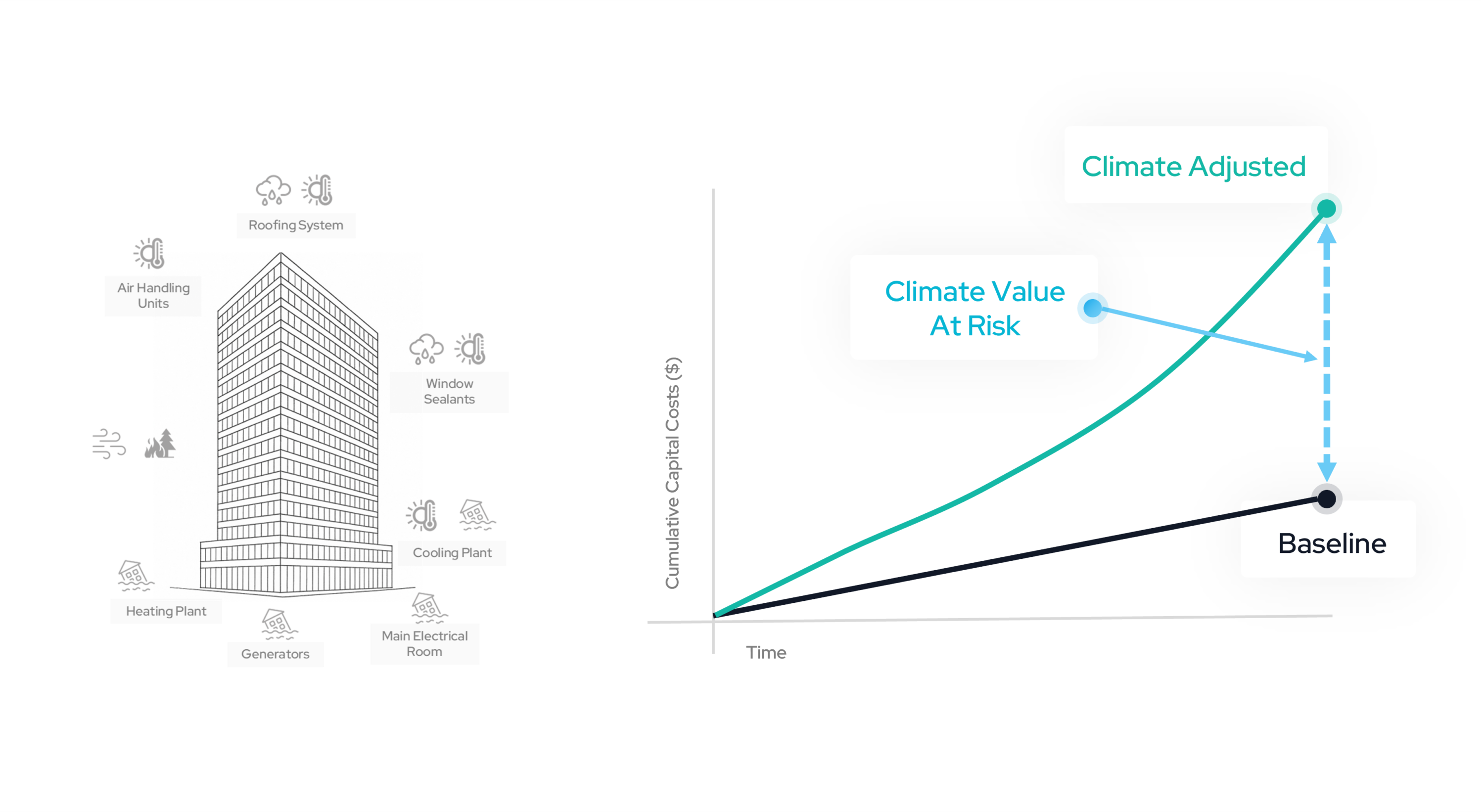
Climate Value at Risk (CVaR) assessments translate physical climate risks into financial impact by quantifying the additional capital costs required to maintain asset performance over time under changed climate conditions. This is calculated by comparing a baseline (historical climate conditions) with a climate-adjusted scenario, enabling asset-level insights that support prioritization and investment decision-making.
Image source: ClimateFirst
Turning climate risk insights into action
As climate risk becomes a more dominant factor in real estate investment and asset management, the importance of credible data will only increase. But progress does not depend on achieving perfect precision. It depends on using transparent, well-structured data to inform better decisions today—while continuing to improve those insights over time. Organizations that take this approach are better positioned to protect asset value, prioritize resilience investments, and meet evolving disclosure expectations.
In the end, climate data and risk assessments are not just about identifying hazards. They are about enabling better financial and operational decisions in a changing climate—and ensuring that uncertainty never stands in the way of progress.
This article was written by Olivia Pink, PMP, Head of Science and Solutions at ClimateFirst. Learn more about ClimateFirst here.
Read more from our partners.