Built for decision-makers
What you don’t know about your buildings can quietly erode value. Understanding and then acting on performance insights have a direct impact on your portfolio’s risk profile, operational efficiency, and long-term value.
Asset Benchmarking offers a fast and cost-effective way to gain high-confidence performance insights for your assets, individually or grouped by characteristic—without public scoring, reporting, or disclosures.

Uncover portfolio risks & opportunities
- Identify underperforming or high-risk assets
- Spot green premium potential
- Screen portfolios for brown discount exposure
Bridge data gaps with confidence
- Benchmark in low-data markets
- Use real GRESB data for proxies to fill in performance gaps
- Support reporting or investment memos with credible data

Prioritize where to retrofit, refinance, or divest
- Compare assets globally against GRESB, CRREM, or ASHRAE
- Tailor strategies and actions by region, sector, and performance tiers
- Equip asset managers and tenants with performance context to act
How it works
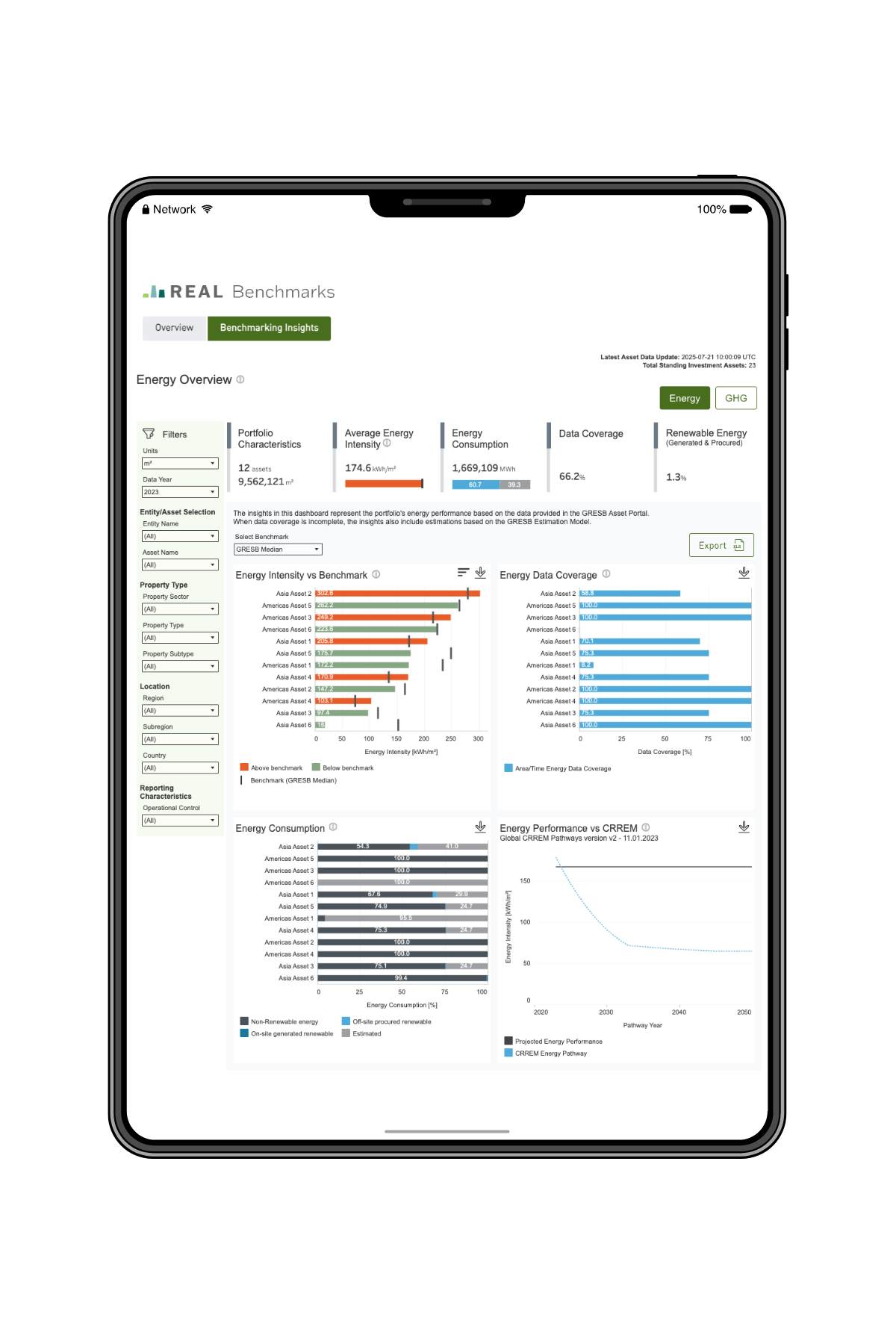
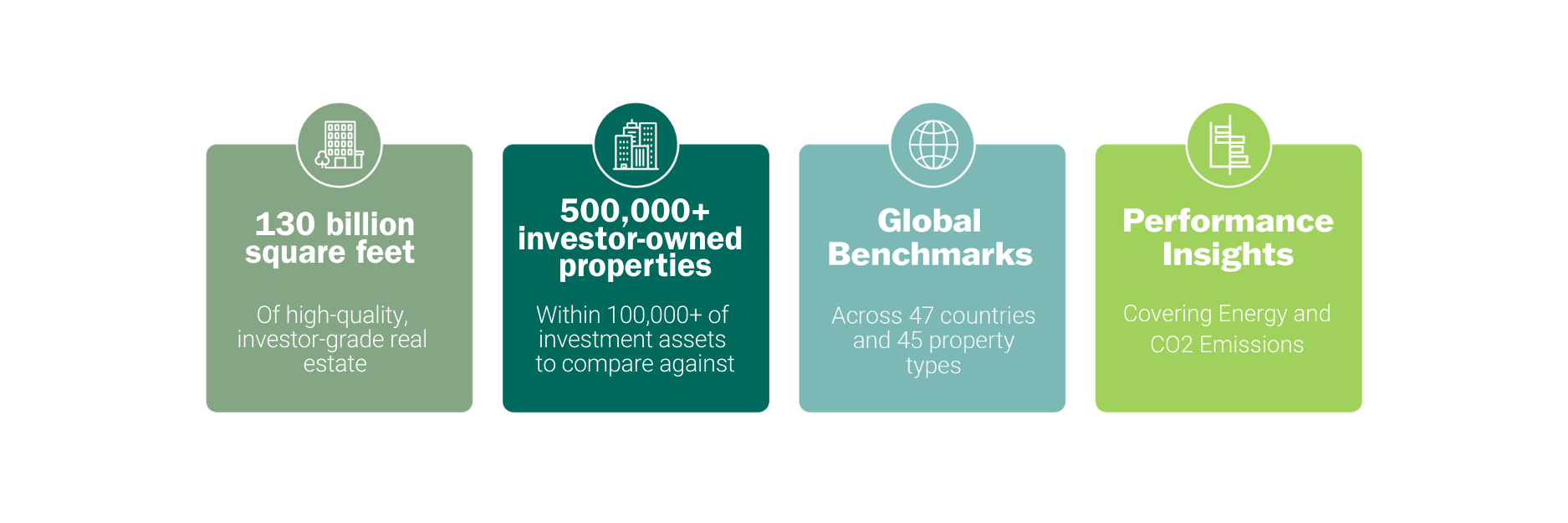
Asset Benchmarking draws from the world’s largest sustainability database of investor-owned property (over 500,000 buildings globally) and applies rigorous quality checks, anonymization, and property type and country-level geographic filtering to give you actionable answers, fast.
All you need to do is upload the asset-level data you have at hand and then use the private dashboard to explore your benchmarks and uncover insights. No submissions required, no assessments or ratings, no reporting burden—just actionable insights built from anonymized buildings and assets of more than 2,000 real estate portfolios, covering 47 countries and 45 property types.
With it you can explore insights based on:
- Your assets’ energy and GHG emissions
- Benchmarks against CRREM and key thresholds from ASHRAE and GRESB
- Your emissions by scope and projected GHG performance
- Advanced estimations for any data gaps you might have
Who uses Asset Benchmarking
Originally developed for GRESB Participants, Asset Benchmarking is now available for a variety of real estate managers and companies looking for asset-level insights. Users include:
- Large, established managers looking for a performance edge
- Small companies just starting to explore how sustainability impacts the bottom line
- Those operating in low-data markets or segments
Have questions? Contact us
Reach out to us below to either get started or ask questions about Asset Benchmarking.
"*" indicates required fields
Asset Benchmarking FAQs
-
No, Asset Benchmarking is available to any real estate manager or company, regardless of whether you participate in the GRESB Assessment. Asset Benchmarking does not require you to report data to GRESB or disclose data to investors.
-
All you need is the asset-level information you already have on hand (such as location, property type, or basic performance data). Asset Benchmarking fills in any gaps using the GRESB Estimation Model, giving you credible insights even in low-data markets.
-
No, the data you provide stays private and only you can access it. There’s no disclosure, no ratings, no external reporting. It’s purely for your internal intelligence and decision-making.
-
The Assessment is a full disclosure and rating framework. Asset Benchmarking is different: it’s a tactical, no-disclosure benchmarking tool. It doesn’t score or rank you, it simply shows how your assets compare.
-
Asset Benchmarking is built from the world’s largest asset-level dataset comprising over half a million investor-owned properties across 47 countries and 45 property types.
-
The dataset is refreshed annually, aligned with the GRESB assessment cycle, ensuring timely comparability and consistency across regions and asset types.
-
Pricing depends on your portfolio’s size and scope. Asset Benchmarking is designed as a low-barrier, tactical product, making it a fast and cost-effective way to get high-confidence insights.