Our industry is engaged in an important dialogue to improve the efficiency and resilience of real assets through transparency and industry collaboration. This article is a contribution to this larger conversation and does not necessarily reflect GRESB’s position.
As the built environment continues to evolve toward healthier, more sustainable buildings, the focus is shifting beyond simply filtering air to creating indoor environments that more closely resemble the natural world. Nature has maintained clean air for millions of years through a combination of atmospheric chemistry, sunlight, rainfall, and naturally occurring ions.
Today, advances in air treatment technology allow building owners to harness one of these natural processes indoors.
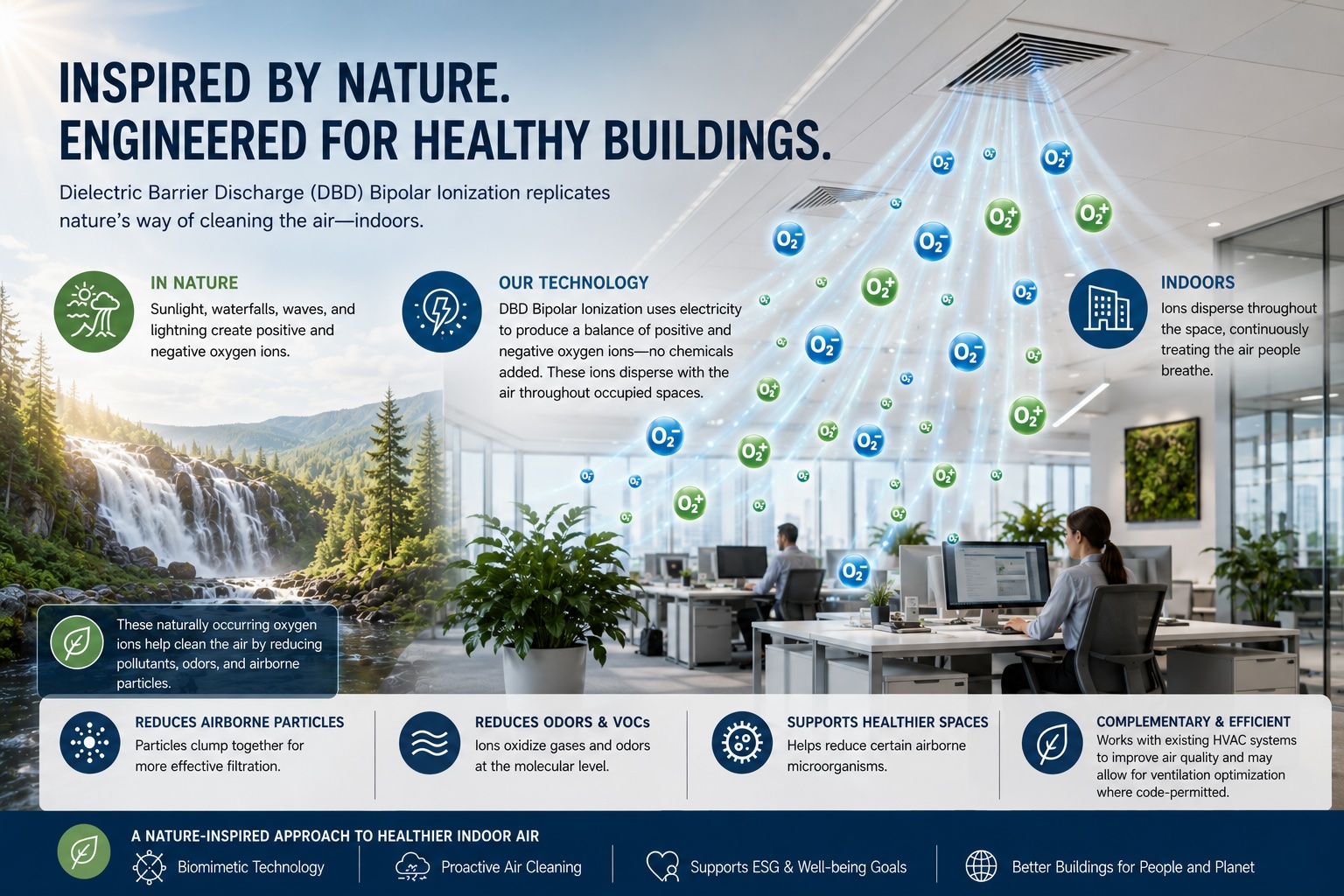
AtmosAir’s Dielectric Barrier Discharge (DBD) Bipolar Ionization technology is designed to replicate the continuous production of oxygen ions that naturally occur in clean outdoor environments. Rather than introducing synthetic chemicals or relying solely on passive filtration, the technology supports natural oxidation processes that continuously reduce airborne contaminants throughout occupied spaces.
For organizations pursuing ambitious sustainability objectives, this represents a practical example of a nature-based approach to improving indoor environmental quality while supporting operational efficiency.
Learning from nature
In the outdoor environment, oxygen molecules are continuously energized by natural phenomena including ultraviolet radiation from the sun, waterfalls, ocean surf, lightning, and cosmic radiation. These energy sources generate positively and negatively charged oxygen ions that participate in atmospheric cleansing processes.
These naturally occurring ions interact with airborne particles, volatile organic compounds (VOCs), odors, and certain microorganisms. Through a series of oxidation and charge-transfer reactions, contaminants are broken down into simpler compounds or aggregated into larger particles that settle more readily or are more effectively removed by filtration (Daniels 2002).
This process is one reason why outdoor air often feels noticeably fresher after a thunderstorm or near moving water.
Indoor environments, however, typically contain significantly lower concentrations of these naturally occurring ions due to enclosed construction, mechanical ventilation, and limited natural ion generation. At the same time, occupants spend approximately 90% of their time indoors, where contaminants can accumulate from people, furnishings, cleaning products, cooking, and outdoor pollution.
Replicating a natural process indoors
AtmosAir’s DBD Bipolar Ionization technology recreates this naturally occurring phenomenon using electricity rather than sunlight or lightning.
On the surface of the ionization tubes, dielectric barrier discharge creates a controlled plasma field that energizes oxygen molecules already present in the air. No chemicals are added to the airstream. Instead, naturally occurring oxygen is converted into a balanced mixture of positive and negative oxygen ions similar to those found outdoors.
These ions disperse throughout occupied spaces, continuously interacting with contaminants wherever the air travels—not only inside the HVAC system, but throughout the occupied zone.
This proactive approach differs from technologies that depend exclusively on contaminated air passing through a filter or treatment device before any action occurs.
Supporting healthier indoor environments
Once released into occupied spaces, oxygen ions contribute to several beneficial air cleaning mechanisms.
They can:
- Help reduce airborne particulate matter by causing fine particles to agglomerate into larger particles that are more easily captured by mechanical filtration (Law and Ho 2025)
- Help oxidize many volatile organic compounds responsible for odors and indoor air pollution (Guo 2018; Law and Ho 2025)
- Help reduce biological contaminants through oxidative reactions that can damage microbial cell structures
- Continuously treat occupied spaces rather than only the air inside ventilation equipment
Because the technology complements existing HVAC systems, it can enhance overall indoor air quality without requiring major infrastructure changes.
A nature-based solution for sustainable buildings
The concept of Nature-Based Solutions is traditionally associated with protecting or restoring ecosystems. Increasingly, however, sustainability professionals recognize that technologies inspired by natural processes can also contribute to healthier and more resilient built environments.
AtmosAir’s technology does not attempt to replace nature—it seeks to emulate one of nature’s own atmospheric cleaning mechanisms within indoor spaces where natural ion concentrations are often depleted.
This aligns with several key sustainability objectives:
- Enhancing occupant health and well-being
- Supporting healthier indoor environmental quality
- Improving resilience against indoor air pollutants
- Reducing dependence on energy-intensive ventilation strategies where permitted by applicable codes and standards
- Extending the effectiveness of existing filtration systems
Importantly, because the technology uses electricity to generate ions from ambient oxygen, there are no consumable chemicals required during normal operation.
Supporting sustainability and occupant wellness goals
Indoor environmental quality is becoming an increasingly important component of building performance and sustainability strategy. Investors, tenants, and building owners increasingly recognize that healthy indoor environments contribute to occupant satisfaction, productivity, and asset value.
For real estate portfolios pursuing broader sustainability strategies, investments that improve indoor environmental quality can support occupant well-being and operational efficiency—complementing the kinds of indoor environmental quality practices evaluated within frameworks such as the GRESB Real Estate Assessment.
When combined with high-performance filtration, ventilation optimization, and continuous indoor air quality monitoring, proactive air purification technologies can become part of a comprehensive healthy building strategy.
Rather than viewing indoor air as something that simply needs to be filtered, building owners have an opportunity to restore some of the natural atmospheric processes that humans evolved with for thousands of years.
Looking forward
As buildings become more airtight and energy efficient, maintaining excellent indoor air quality becomes increasingly important. Nature has already demonstrated an effective method for continuously cleaning the atmosphere through oxygen ion chemistry.
By recreating this naturally occurring process inside buildings, dielectric barrier discharge bipolar ionization offers a practical example of biomimicry in building technology—using principles refined by nature to create healthier, more sustainable indoor environments.
For organizations pursuing stronger sustainability performance, healthier buildings, and stronger occupant outcomes, technologies inspired by nature may play an increasingly valuable role in the future of sustainable real estate.
Sources
- Daniels, S. L. 2002. “On the Ionization of Air for Removal of Noxious Effluvia: Air Ionization of Indoor Environments for Control of Volatile and Particulate Contaminants with Nonthermal Plasmas Generated by Dielectric-Barrier Discharge.” IEEE Transactions on Plasma Science 30 (4): 1471–85. https://ieeexplore.ieee.org/document/1167642
- Guo, B. 2018. Full-Scale Chamber Testing of Air Cleaner Performance for the Removal of Volatile Organic Compounds. Internal Report no. 2018BEESL-ATMOSAIR-P1. Building Energy and Environmental Systems Laboratory, Syracuse University. Prepared for AtmosAir Solutions. https://atmosair.com/wp-content/uploads/2023/07/Syracuse-University-Chamber-Testing.pdf
- Law, D., and E. Ho. 2025. “Effect of Nonthermal Plasma Technology on Reducing Airborne Contaminants in an Indoor Setting.” ASME Journal of Engineering for Sustainable Buildings and Cities 6 (2): 024501-1–024501-7. https://doi.org/10.1115/1.4068505
This article was written by Sam Michael, General Manager at AtmosAir Asia. Learn more about AtmosAir here.