Horizon Industrial Parks, Blackstone’s logistics platform in India, is the largest and fastest-growing industrial and logistics infrastructure developer in the country. Launched in 2022 with 6 million square feet of seed assets, the platform has scaled to 58 million square feet across 45 parks in 10 key markets, spanning over 2,200 acres nationwide. Today, it serves over 100 global and domestic occupiers, with nearly 60% of our clients being Fortune 500 companies.
Introduction
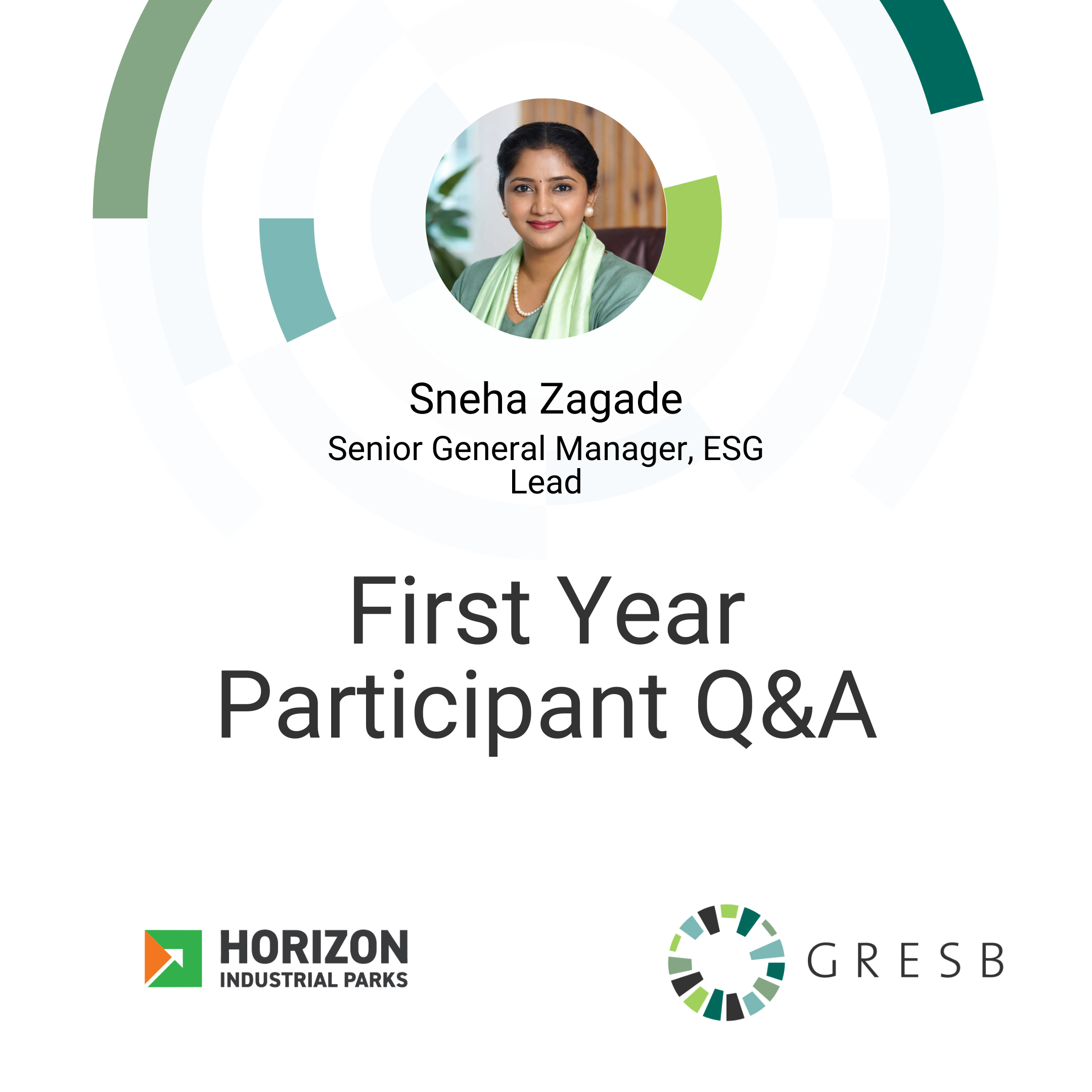
- Name & title: Ms Sneha Zagade, ESG Lead
- GRESB Assessments, tools, or products: GRESB Real Estate Assessment (Standing Investments & Development)
- Region(s) of operation: India (Asia)
- Sector: Industrial Real Estate
- AuM or market capitalization: ~INR 9,877 Crore (approx. USD 1.2 billion)
What were the key drivers behind Horizon’s decision to participate in GRESB, and how did the organization prepare internally for its first submission across both Standing Investments and Development?
Horizon’s decision to participate in GRESB was driven by a clear ambition to benchmark its Sustainability performance against global standards and align with institutional investor expectations As a young but rapidly scaling platform in India’s industrial and logistics sector, we viewed GRESB not merely as a disclosure exercise,
GRESB provided a common, credible language to assess how our design-first philosophy, IGBC Platinum-certified developments, integrated management systems, and governance frameworks compared with global peers—including mature portfolios within large international investment platforms. Equally important, it helped us identify gaps early and strengthen both standing assets and the development pipeline.
Preparation for the first submission began well before the assessment year. We strengthened governance through a dedicated ESG Steering Committee, embedded sustainability responsibilities across asset management, development, operations, and procurement teams, and aligned internal policies with GRESB indicators. Data systems for energy, water, waste, health & safety, and climate risk were standardized across parks, while development guidelines were refined to improve consistency in sustainability performance across new projects.
This structured, portfolio-wide approach enabled Horizon to complete its first submission with clarity and confidence.
How do GRESB benchmarks, data, and insights support Horizon’s sustainability and operational strategy?
GRESB plays a critical role in translating Horizon’s sustainability vision into measurable, decision-useful outcomes. The benchmarking against global peers enables us to objectively assess our position across governance, operations, and development, helping distinguish genuine strengths from areas requiring further institutionalization.
The performance scoring and comparison has been particularly valuable and instructive for a growing platform like Horizon Industrial Parks. While some governance and management practices typical of older, more mature portfolios are still evolving, GRESB has helped us prioritize improvements that are most material to operational resilience and long-term value creation—rather than adopting policies for form’s sake.
GRESB insights have helped us prioritize actions that directly informed refinements to our operational strategy, including enhanced performance data capture, deeper tenant engagement on energy and water use, and sharper focus on climate risk, biodiversity, and embodied carbon in development decisions. The results also provide a structured way to communicate performance and progress to internal leadership, investors, and partners, using a globally recognized framework.
Most importantly, GRESB reinforced a culture of continuous improvement—supporting data-driven decision-making in risk management, capital allocation, and asset-level operations.
What are the key challenges and opportunities in maintaining safe, resilient, and efficient operations while ensuring meaningful stakeholder engagement and community impact?
Horizon’s industrial parks function as large, living ecosystems, with daily footfalls ranging from 2,000 to over 10,000 people, alongside continuous movement of goods and vehicles. Ensuring safety, efficiency, and resilience at this scale presents unique operational challenges—particularly around people and logistics movement, heat stress, water stewardship, waste management, and air quality.
To address this, Horizon has embedded safety-by-design and operational discipline into park planning and management, supported by structured EHS governance. Clear intra-park mobility systems, dedicated pedestrian pathways, fire and emergency protocols, and continuous EHS audits are complemented by regular training sessions for tenants, contractors, and workforce teams covering road safety, fire safety, health, and emergency preparedness.
Environmental challenges such as heat and water stress are addressed through extensive landscaping (~15% green cover), IGBC Platinum–certified design approaches, on-site water treatment and reuse, and climate-responsive infrastructure designed to support cooler microclimates, improved thermal comfort, and resilient park operations.
Beyond operations, Horizon views community engagement as a core opportunity rather than an obligation. Initiatives such as recycled-plastic benches, upgraded sanitation facilities in schools near parks, solar lamp distribution, skilling programs, and local infrastructure support, help build trust and shared value—strengthening our social licence to operate while creating tangible, long-term community impact.
How does this approach help identify and manage physical climate risks—such as heat stress, flooding, and water scarcity—and how are these insights integrated into long-term asset resilience planning, capital expenditure decisions, and development standards?
Climate risk and scenario analysis are embedded within Horizon’s enterprise risk management and development planning processes. During site selection and master planning, physical risks such as heat stress, flooding, and water scarcity are assessed using soil studies, topographical assessments, hydrology analysis, and local climate data.
Mitigation measures are integrated directly into asset standards. Heat stress is addressed through extensive landscaping, urban forests, butterfly gardens, reflective roofing, louvers, shaded pedestrian corridors, and water bodies that help regulate microclimates. Flood risk are mitigated through elevated site planning, rainwater harvesting systems, bioswales, ponds, and enhanced stormwater management infrastructure. Water scarcity is managed through closed-loop systems, 100% on-site wastewater treatment and reuse, groundwater recharge, and real-time water monitoring.
Climate considerations also influence material selection and construction methods, including the use of low-embodied-carbon materials, recyclable steel structures, and pre-engineered buildings. By embedding resilience into design and capital planning from the outset, Horizon enhances asset durability, operational continuity, and long-term value.
How does Horizon integrate sustainability expectations into procurement processes, contractor requirements, and supplier monitoring to ensure responsible, safe, and resilient operations across both standing assets and development projects?
Sustainability expectations are embedded into Horizon’s procurement processes through a structured supplier governance framework. All suppliers and contractors are required to comply with Horizon’s Supplier Code of Conduct covering ethics, labour standards, health and safety, environmental compliance, and human rights.
Sustainability considerations form part of supplier due diligence, onboarding, and ongoing performance evaluation, with clear contractual clauses reinforcing accountability. Horizon is further strengthening this approach through a Sustainable Supply Chain Initiative (2025–26), aimed at systematically assessing vendor performance across governance, including water stewardship, carbon management, labour practices, and safety. The programme is designed to both monitor compliance, but also to build capacity—supporting suppliers in aligning with Horizon’s sustainability expectations.
By integrating sustainability into procurement decisions across both standing assets and development projects, Horizon extends responsible practices beyond its direct operations and enhances resilience and transparency across the portfolio.
Now that you have completed your first GRESB submission, what advice would you offer others preparing to undertake their first GRESB assessment?
Start early and focus on building strong foundations rather than aiming for perfection. GRESB is a multi-year journey that rewards early investment in data systems, governance structures, and operational discipline.
Understanding the intent behind the indicators is as important as understanding the intent behind the Align internal teams early, define roles and responsibilities clearly, and involve asset and development teams from the outset. For fast-growing platforms, GRESB offers a unique opportunity to establish robust systems before operational complexity increases.
We would also encourage first-time participants to actively engage with the GRESB team and technical resources. Early dialogue helps contextualize regional market realities, clarify expectations, and identify the most relevant pathways for improvement. Partnering with the right advisors or collaborators can further accelerate learning and avoid common pitfalls.
Ultimately, the value of GRESB lies not in the score alone, but in the discipline, clarity, and strategic focus it brings to sustainability and asset management long-term planning.
Looking ahead, what are Horizon’s sustainability priorities for 2026 and beyond, and how will GRESB support progress?
Horizon’s next phase focuses on deepening climate resilience, reducing embodied and operational carbon, and scaling impact across a growing portfolio.
Near term, priorities include expanding renewable energy capacity, strengthening tenant-level energy and water engagement, enhancing climate risk assessments across all assets, and integrating embodied carbon considerations more systematically into development and procurement decisions. Horizon is targeting a 65% reduction in Scope 1 and 2 emissions by 2035 and progressing toward net-zero operations by 2050.
As the platform matures, GRESB will continue to play a critical role in this journey—providing an annual benchmark to track progress, refine priorities, and support performance excellence.
As Horizon grows, GRESB is ensuring sustainability remains measurable, embedded, and aligned with global best practices.